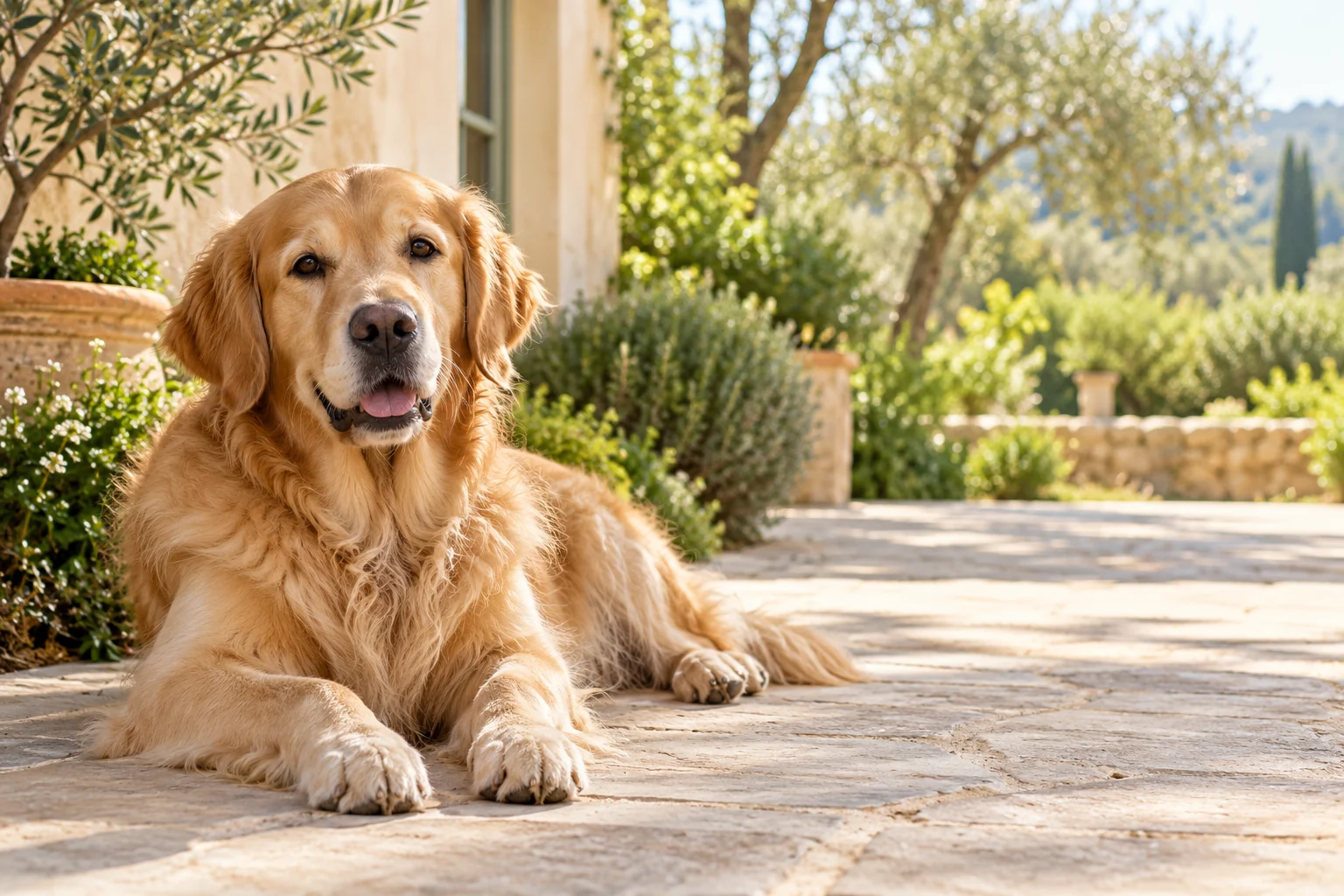
How far do golden retrievers walk in a normal week? When 23 owners on r/goldenretrievers gave an actual daily number, the typical answer was about 3 miles (5 km). The spread ran from barely half a mile to more than 5 miles a day. If your golden plants their feet after one block, or your daily mileage collapsed after a busy month, you are in good company, and the routine can be rebuilt.
Quick answer
- Typical owner-reported distance: median 3.1 miles (5.0 km) a day. The middle half of owners walked 2.0 to 4.7 miles (3.2 to 7.5 km).
- Time guidance: the UK's Royal Kennel Club lists the breed's exercise need as "more than 2 hours per day." That is time, not miles, and it covers more than leash walking.
- Why the two don't match: 3 miles is roughly one hour at a typical human walking pace. Owners fill the rest with off-leash running, swimming, fetch, daycare and training.
- Off-leash changes everything: several owners said their dog covers about twice their own distance when it can run free.
Use the planner below to turn your own walk time and pace into miles, and to see where your routine sits next to the owners in that thread.
Golden retriever daily walk planner
Pace presets come from typical human walking speeds, not dog data. If you time a real walk, choose "enter my own pace" for a better estimate. Nothing you type is saved.
How far do golden retrievers walk each day, according to owners?
The owners who gave a number reported a median of 3.1 miles (5.0 km) a day, and half of them fell between 2.0 and 4.7 miles. Almost nobody reported a regular daily walk above about 5.5 miles, even though several dogs could clearly go further.
We read every reply in the October 2026 r/goldenretrievers thread "How far are we walking our goldies?", which had 89 comments. We kept the 23 replies that gave a usable daily distance and converted weekly totals, kilometers and step counts to miles. Photo-only replies and answers like "as far as he wants" were left out.
| Daily distance | Owners (of 23) | What these routines looked like |
|---|---|---|
| Under 1.5 mi (under 2.4 km) | 2 | "About 1 km, then he says no more," or "good for a mile, then pulls home" |
| 1.5–2.9 mi (2.4–4.7 km) | 8 | Two short neighborhood walks, often split around school runs or work |
| 3–4.4 mi (4.8–7.1 km) | 7 | One longer morning walk plus a short evening loop |
| 4.5 mi and up (7.2 km+) | 6 | Off-leash trails, beach time, sport dogs, weekly mileage of 35–40 |
What this data is, and what it isn't
This is one community thread, not a survey. Owners who walk a lot are probably more eager to answer, and many numbers are rough ("3-ish miles"). Most replies described the owner's distance, and off-leash dogs cover more ground. Read it as an honest snapshot of real routines, not as a target. It is still more concrete than the time-only advice most breed guides give.
How does walking distance change with age?
Eleven owners in the thread gave both an age and a distance. The longest regular walks came from dogs aged about 1 to 6, and the two 10-year-olds walked 1.5 to 3 miles. With a sample this small, these are examples rather than averages.
| Dog's age | Reported daily distance | Routine detail from the owner |
|---|---|---|
| 8 months | A little over 2 mi (3.4 km) | Daily walks, no further detail |
| 1 year | About 5 mi (8 km) | 3 mi morning + 2 mi evening, off lead at the dog's own speed |
| About 2 years | 2 mi (3.2 km) | Two 1-mile walks plus brain games and training |
| About 2 years | 6–8 km (3.7–5 mi) | One 1.5–2 hour walk, plus off-lead zoomies |
| 5 years | 5–6 km (3–4 mi) | "Hard limit" of about 8,000 steps, then wants to go home |
| 6 years | About 5 mi (8 km) | 4 mi morning + 1 mi evening |
| About 7 years | About 2.5 mi (4 km) | 2 mi neighborhood loop + two short bus-stop walks + backyard fetch |
| 7 years | About 3 mi (owner) | Hikes several times a week; the dog covers 2–3 times the owner's distance |
| 8 years | 2 mi (3.2 km) | Split into one walk of just over a mile and two short ones |
| About 10 years | About 1.5 mi (2.4 km) | Starts pulling for home after that |
| 10 years | 2.5–3 mi (4–4.8 km) | Every day; the owner's fourth golden on the same routine |
Puppies: owners disagree, so ask your vet or breeder
Puppy routines in the thread were all over the place. One 5-month-old got a 15-minute evening walk plus 2–3 hours at a dog park. A 6-month-old would only go "around one block" because traffic scared her. A 7-month-old did 30 minutes in the morning plus an off-leash hike. One owner of a 1-year-old said they don't follow the popular "five minutes per month of age" rule of thumb. Because owners genuinely disagree here, ask your vet or breeder to set a puppy plan, and treat confidence on walks as a skill to build. Our guide to socializing a golden retriever puppy covers how to grow that confidence step by step.
Seniors: the same routine, a little shorter
The older dogs in the thread kept walking daily, usually in shorter, split sessions. One owner mentioned a golden friend, a month short of 16, who "happily does three miles if the weather is cool." Weather came up too: one owner said their distances are "subject to change based on weather." Let your senior's pace, not last year's distance, set the route.
Why do breed guides talk about hours instead of miles?
Time is easier to compare across dogs than distance, because a sniffy leash walk, a jog and an off-leash run cover very different ground in the same hour. The breed guidance most often quoted is time-based.
The Royal Kennel Club's golden retriever breed page lists exercise as "more than 2 hours per day" and the breed's size as "Large." The typical human walking speed is about 1.4 m/s, or 3.1 mph (5.0 km/h), with a usual range of about 2.5 to 3.7 mph. At that pace, two hours of nonstop walking would be roughly 6 miles. That is more than almost every owner in the thread reported.
So where does the rest of the time go?
The owners who hit two hours or more rarely did it with leash miles alone. They mentioned:
- Off-leash running: "I walk 2-3 miles and he runs at least twice that."
- Water: beach afternoons, swims once or twice a week, splashing in creeks.
- Daycare and dog parks: one almost-9-year-old does 10–12 hours of daycare "and still comes home with energy."
- Fetch and play: backyard fetch sessions between walks. If yours ignores the ball, see why some golden retrievers don't retrieve.
- Brain work: training games and puzzle toys on short-walk days.
If you want to see what a balanced day looks like beyond distance, this Golden Hearts video walks through a daily mix of sniffing, training, puzzle toys, exercise and rest for a calmer golden.
How much farther does a golden go off leash?
Several owners estimated that their golden covers about two to three times their own distance off leash. One owner who stops around 8 km joked that the dog "probably does 20" by running and swimming.
Step counts tell the same story. One owner walks about 4,000 steps on a 35–40 minute morning outing, while the dog "does probably 12000," darting into the brush after rabbits and coming back. So if you track only your own distance, you are likely underestimating an off-leash golden's day. A collar-mounted tracker gives a much clearer picture. Our roundup of dog fitness trackers for golden retrievers explains what those devices actually measure.
The flip side: sniffy walks cover very little ground
Not every golden wants mileage. "We move about 10 feet per minute. She just sniffs everything in sight," one owner wrote. Another called getting her dog to do 5K "like negotiating with a terrorist," so they do slower sniffy walks instead. A slow, nose-down walk can fill an hour with less than a mile. For dogs like these, time and engagement are a better measure than distance.
How to build a walking routine your golden will actually keep
The routines that lasted in the thread were steady rather than heroic. Here is a practical way to set one up:
- Measure a normal week first. Track your real walks for 7 days with a phone or tracker before setting any goal. Many owners discover their "daily 3 miles" is really 2.
- Split the day. Many routines in the thread used a longer morning walk and one or two short loops later. That is easier to keep than one long outing.
- Pick one "big" day a week. Some owners did one long walk of 10 miles or more each week, or a weekly bike run, rather than pushing every day.
- Swap miles for engagement on busy days. A 20-minute sniff walk plus a 10-minute training game beats a rushed, frustrating march.
- Check the gear. Long walks go better with a harness that fits. Our Front Range Flex fit and sizing guide shows how to measure your golden, and our training equipment review covers leashes and long lines.
- Watch the dog, not the number. Owners described clear "done" signals: sitting down, turning for home, pulling back toward the house. Respect them and adjust the next day.
- Restart without guilt. If the routine slipped during a hard month, go back to the shorter version that worked and build up again over a couple of weeks.
Common mistakes when planning golden retriever walks
- Treating "2 hours" as "2 hours of leash walking." The time guidance covers all exercise. Very few owners in the thread walked that long on a leash.
- Comparing your dog with the highest numbers online. The dog logging 35–40 miles a week has an owner who is "out in the woods a lot." A 1.5-mile golden can be just as happy.
- Counting only your own miles. Off-leash dogs often cover two to three times your distance.
- Ignoring weather. Owners mentioned adjusting distances to the weather. Plan hot-day alternatives such as early-morning walks, shade and indoor games.
- Dragging a reluctant dog farther. Owners of reluctant walkers had more luck with a car ride to a new spot, a familiar companion dog or shorter, sniffier routes than with pulling.
- Forgetting the brain. Several owners paired short walks with training and puzzle games to keep their goldens settled.
For Golden Families: This guide was written with family-owned goldens in mind — the shedding, training, and whole-family experience of this breed.
Frequently asked questions
How many miles a day should I walk my golden retriever?
There is no single right number. In a 23-owner sample from r/goldenretrievers, the median was about 3.1 miles (5.0 km) a day, and half of owners walked 2.0 to 4.7 miles. Breed guidance is time-based instead: the Royal Kennel Club lists more than 2 hours of exercise a day, which includes play, running and training as well as walks.
Is a 5 km walk enough for a golden retriever?
For many owners in the thread, yes. 5 km (3.1 miles) is almost exactly the median they reported, and several said their dog was tired after about 5–6 km. Many of them also added play, fetch or off-leash time on top.
How far can a golden retriever hike?
Some owners reported occasional long hikes of 8–9 miles, and one described monthly day hikes of 20+ miles as "a long day" for their dog. Those were occasional outings, not daily routines. Build up to long hikes gradually.
How many steps does a golden retriever take on a walk?
It depends on the dog and the walk. One owner said their 5-year-old has a limit of about 8,000 steps (about 5–6 km). Another estimated that their dog does about 12,000 steps while the owner does 4,000, because the dog runs back and forth off leash.
Why does my golden retriever refuse to walk far?
Owners in the thread described dogs that stop after a block because of traffic noise, miss a companion dog, or only want to go out if the car is involved. Shorter sniff walks and driving to a new spot or a dog park were the workarounds owners mentioned, and one puppy was braver with her older buddy dog along. If the change is sudden, check with your vet.
Should I count off-leash time as part of the daily distance?
Count it as active time. Off-leash goldens often cover two to three times their owner's distance, so your own step count understates it. A collar-mounted tracker gives a better estimate than your phone.
The bottom line
How far do golden retrievers walk? Real owners say about 3 miles (5 km) on a typical day, with plenty of happy dogs doing 1.5 miles and some doing more than 5. The bigger lesson from the community is that a routine you can keep, with split walks, one bigger outing a week, play and brain games, matters more than chasing a number. If your plan fell apart, start again from the short walk that worked, and let your golden show you the right distance.